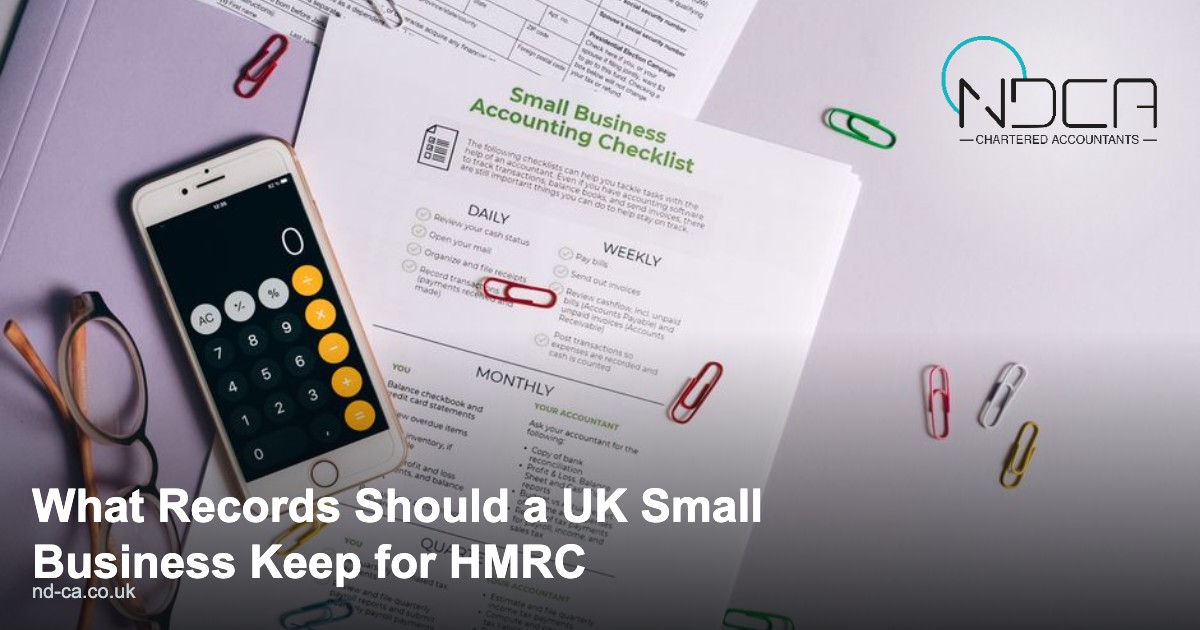
What records should a UK small business keep for HMRC? If HMRC ever opens an enquiry into your business, the first thing they will ask for is your records. This article explains exactly what records a UK small business must keep, how long to keep them, and how to stay organised — whether you are a sole trader, a limited company director, a landlord, or a freelancer. Get this right and you will save time, avoid penalties, and have accurate numbers to run your business on.
- What Records Should a UK Small Business Keep for HMRC: Why It Matters
- Records sole traders must keep
- Records limited companies must keep
- VAT records
- Payroll records
- How long to keep records
- Digital records vs paper records
- Common record-keeping mistakes
- Frequently asked questions
What Records Should a UK Small Business Keep for HMRC: Why It Matters
HMRC can open a compliance check into any business at any time. If you cannot produce proper records, HMRC can estimate your tax bill — and that estimate will almost always be higher than what you actually owe. On top of that, poor records lead to errors in your tax returns, missed expenses, and cash flow problem s.
s.
Good bookkeeping is not just about satisfying HMRC. It gives you a clear picture of your business finances so you can make better decisions, spot problems early, and plan ahead with your cash flow.
HMRC can charge penalties of up to £3,000 for failing to keep adequate records for self assessment purposes. For VAT, penalties can apply separately. The cost of getting it wrong is far higher than the effort of keeping things in order from the start. See HMRC’s official guidance on keeping business records for the full requirements.
Records sole traders must keep
Knowing what records should a UK small business keep for HMRC starts here if you trade as a sole trader. If you are self-employed, you are required to keep records that support your self assessment tax return. HMRC does not prescribe a specific format, but the records must be accurate, complete, and available if requested.
Income records
- All sales invoices you have issued
- Records of cash sales, even if no invoice was raised
- Bank statements showing money received
- Payment platform records (PayPal, Stripe, Sumup, etc.)
- Till rolls or point-of-sale reports if you take cash payments
Expense records
- Receipts and invoices for every business purchase
- Bank and credit card statements
- Mileage logs if you claim mileage allowance
- Records of any business use of your home (utility bills, broadband, mortgage or rent proportions)
- Records of capital items purchased — equipment, tools, vehicles
Other records sole traders should retain
- Grants received (including any COVID-19 support payments)
- Records of any goods taken from stock for personal use
- Loan agreements if you borrowed money for the business
- Previous tax returns and any correspondence with HMRC
From April 2026, sole traders and landlords with income over £50,000 will need to comply with Making Tax Digital for Income Tax Self Assessment. This means keeping digital records and submitting quarterly updates to HMRC. Setting up good habits now will make that transition much smoother.
Records limited companies must keep
Limited companies have more extensive obligations than sole traders. You must keep records for both Companies House and HMRC purposes. Failing to maintain statutory records is a criminal offence under the Companies Act 2006.
Financial records
- All money received and spent by the company
- Details of assets owned by the company
- Debts the company owes or is owed
- Stock the company holds at the end of each financial year
- The stocktaking records used to calculate the year-end stock figure
- All goods bought and sold, with details of who you bought from and sold to (unless you run a retail business)
These records are used to prepare your annual accounts and your corporation tax return. In 2026/27, the corporation tax rate is 19% on profits under £50,000 and 25% on profits above £250,000, with marginal relief in between.
Statutory registers
Every limited company must also maintain statutory registers. These must be kept at your registered office or at a single alternative inspection location notified to Companies House.
- Register of members (shareholders)
- Register of directors
- Register of directors’ residential addresses (this is kept private)
- Register of secretaries (if you have one)
- Register of people with significant control (PSC register)
- Minutes of board meetings and shareholder meetings
- Copies of any resolutions passed
- Records of share allotments, transfers, and any charges over company assets
Director loan accounts
If you take money from the company beyond your salary and dividends, this must be recorded as a director’s loan. Keep a running record of all amounts drawn and repaid. HMRC pays close attention to director loan accounts — outstanding balances can trigger additional tax charges.
VAT records
If your taxable turnover exceeds £90,000 in any rolling 12-month period in 2026/27, you must register for VAT. Once registered, you are required to keep detailed VAT records.
What VAT records must include
- Copies of all VAT invoices you issue
- Copies of all VAT invoices you receive
- Your VAT account — a summary of output tax and input tax for each period
- Import and export records if applicable
- Any VAT self-billing arrangements
- Records relating to any VAT scheme you use (Flat Rate, Cash Accounting, Annual Accounting)
VAT-registered businesses must already keep digital records and file their VAT returns through Making Tax Digital-compatible software. Paper VAT records alone are no longer sufficient for most businesses.
Payroll records
If you employ staff, what records should a UK small business keep for HMRC extends to payroll too. If you employ staff, you must keep payroll records for every employee. These support your Real Time Information (RTI) submissions to HMRC and are needed if HMRC ever queries an employee’s tax or National Insurance record.
Payroll records to retain
- Each employee’s name, address, date of birth, and National Insurance number
- Their tax code and payroll number
- Gross pay, deductions, and net pay for each pay period
- Employer and employee National Insurance contributions
- In 2026/27, the employer NI rate is 15% on earnings above £5,000 per employee per year
- Any statutory payments — sick pay, maternity pay, paternity pay
- P45s issued to leavers
- Details of any expenses or benefits provided to employees
If you use a subcontractor under the Construction Industry Scheme, you need to keep CIS deduction statements and records of all payments made. The CIS returns you file monthly must be backed by these records.
Keeping payroll records organised is especially important now that the employer NI threshold has dropped to £5,000. Many small employers are paying more employer NI than before, so accurate records help you claim the Employment Allowance correctly and avoid overpaying.
How long to keep records
The length of time you must keep records depends on your business type and the type of record.
Sole traders and partnerships
Keep records for at least five years after the 31 January submission deadline for the relevant tax year. For example, records for the 2026/27 tax year (submitted by 31 January 2027) must be kept until at least 31 January 2032.
Limited companies
Keep financial records for at least six years from the end of the accounting period they relate to. Statutory registers must generally be kept for the life of the company and for a period afterwards — check Companies Act requirements or speak to your accountant.
VAT records
Keep VAT records for six years as standard. If you are using the VAT margin scheme, the Capital Goods Scheme, or land and property transactions, some records must be kept for longer — check the latest HMRC guidance for specific rules.
Payroll records
Keep payroll records for three years after the end of the tax year they relate to. Records relating to statutory payments may need to be kept for longer.
Digital records vs paper records
HMRC accepts both digital and paper records in most cases, but the direction of travel is firmly towards digital. VAT-registered businesses must already use digital records. Making Tax Digital for Income Tax will extend this to many sole traders and landlords from April 2026.
Benefits of going digital now
- Easier to search and retrieve records during an HMRC enquiry
- Less risk of records being lost, damaged, or destroyed
- Real-time visibility of income and expenses
- Faster preparation of tax returns and management accounts
- Bank feeds and receipt scanning save significant manual entry time
Many small businesses use cloud accounting software such as Xero to keep their records. If you are new to it, Xero training can help you set it up properly and use it efficiently from the start.
If you do keep paper records, store them securely and keep backups. HMRC will not accept ‘the records were lost in a flood’ as a reason for incomplete returns — they expect you to have taken reasonable steps to protect them.
Scanning paper receipts
HMRC generally accepts scanned copies of paper documents, provided the scan is a complete and legible reproduction of the original. Once scanned and backed up, you do not need to keep the physical paper in most cases — but check HMRC’s guidance for any specific document types before destroying originals.
Common record-keeping mistakes
These are the errors that most frequently cause problems for small businesses during HMRC enquiries or when preparing tax returns.
Mixing personal and business finances
Using a personal bank account for business transactions makes it very difficult to separate business income and expenses. Open a dedicated business account from day one. For limited companies, this is a legal requirement — company money belongs to the company, not the director.
Missing or incomplete receipts
HMRC can disallow any expense claim that cannot be supported by a receipt or invoice. The rule of thumb is simple: no receipt, no claim. Use a receipt-scanning app or photograph receipts immediately so nothing gets lost.
Not recording cash transactions
Cash sales must be recorded just like any other income. Businesses that deal heavily in cash — trades, market stalls, catering — are more likely to attract HMRC scrutiny. A complete and consistent record of cash in and out is your best protection.
Ignoring mileage logs
If you claim mileage for business travel, you need a mileage log showing the date, destination, purpose of the journey, and miles travelled. A rough estimate is not acceptable. Apps that log journeys automatically can save a lot of effort here.
Deleting old records too early
Many business owners clear out old files not knowing how long HMRC can go back. In cases of fraud or negligence, HMRC can investigate up to 20 years back. For most compliance enquiries the window is shorter, but the safest approach is to retain records for at least the statutory minimum and keep a clear archive.
Not keeping management accounts
You do not have to produce management accounts by law, but doing so regularly means you always have an up-to-date view of your business finances. It also means your year-end figures are far easier to prepare — and your accountant’s fees are likely to be lower.
If you run a business in construction, e-commerce, or work as a freelancer, good record-keeping habits are especially important because your income and expenses can be variable and complex. Getting the foundations right from the start will save significant time and cost further down the line.
The best time to sort out your records is before HMRC asks for them. If your records are currently a mess, start by separating your bank accounts, setting up simple bookkeeping software, and working through your last 12 months of transactions. It is a manageable job when you break it down — and the peace of mind is worth every minute spent on it.
Frequently asked questions
What happens if I do not keep proper records for HMRC?
HMRC can charge a penalty of up to £3,000 for failing to keep adequate records for self assessment. They can also use estimated figures to calculate your tax bill, which is likely to be higher than your actual liability. Separate penalties apply for VAT record failures.
Do I need to keep original paper receipts or are scans acceptable?
HMRC generally accepts scanned copies of receipts provided they are complete and legible. Once scanned and securely stored, you do not normally need to keep the physical paper. Check HMRC guidance for any specific document types before destroying originals.
How long does a sole trader need to keep tax records?
At least five years after the 31 January filing deadline for the relevant tax year. So for the 2026/27 return filed by 31 January 2027, you must keep records until at least 31 January 2032.
How long must a limited company keep its records?
Financial and accounting records must be kept for at least six years from the end of the accounting period they relate to. Some statutory registers must be kept for the life of the company and beyond — check Companies Act 2006 requirements.
Does a small business need to keep records digitally?
VAT-registered businesses must already keep digital VAT records under Making Tax Digital. From April 2026, self-employed people and landlords with income above £50,000 will need to keep digital records for income tax purposes too. Even if you are not yet required to go digital, doing so now makes your record-keeping easier and more accurate.
What records do I need to keep if I use the Construction Industry Scheme?
If you are a contractor, you must keep records of all payments made to subcontractors, the CIS deductions applied, and the monthly returns filed with HMRC. Subcontractors should keep all deduction statements received from contractors, as these are used to reclaim deductions through their tax return. Proper records support accurate CIS returns and prevent disputes over amounts deducted.
Areas we cover
NDCA works with clients across the following regions. If you’re based in one of these areas, our team can help with the accounting issues covered in this article.