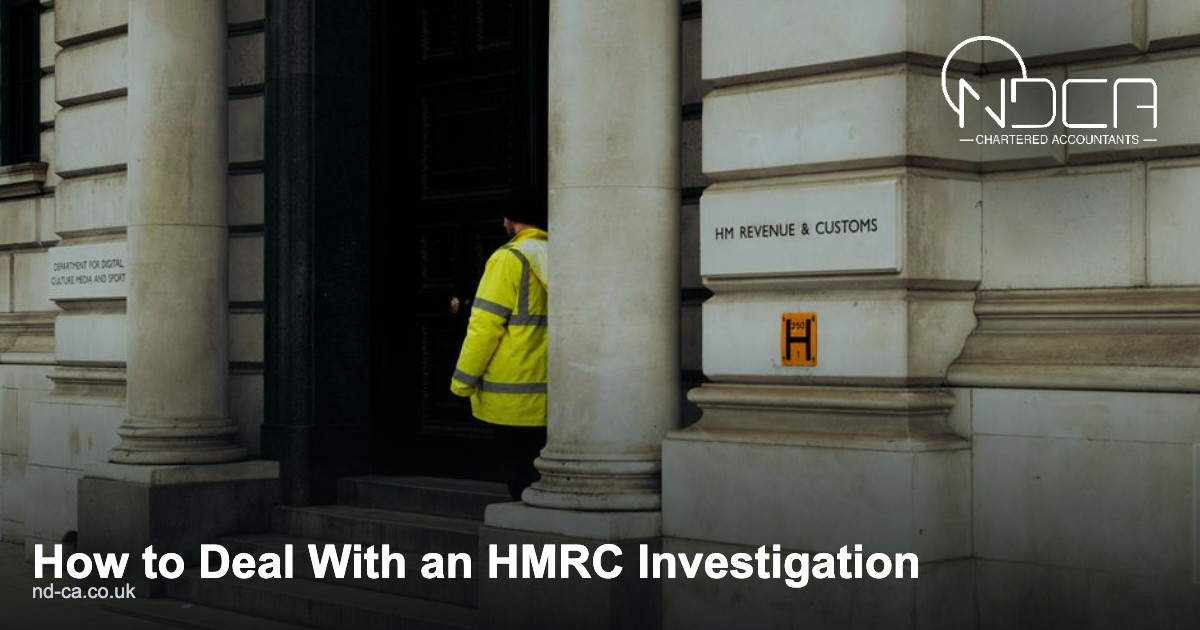
An HMRC investigation can feel alarming, but knowing what to expect makes a significant difference. This article explains why HMRC opens investigations, the different types they carry out, what happens at each stage, and how to handle the process without making things worse. It is aimed at sole traders, limited company directors, landlords, and anyone who completes a tax return in the UK.
- What is an HMRC investigation?
- What triggers an investigation?
- Types of HMRC investigation
- What happens during an investigation?
- How to respond to HMRC
- Records you need to have ready
- Penalties and possible outcomes
- How to reduce your risk of an investigation
- Frequently asked questions
What is an HMRC investigation?
An HMRC investigation is a formal review of your tax affairs. HMRC wants to check that the tax you have paid matches what you actually owe. Investigations can look at a single tax return, a specific issue such as VAT or PAYE, or your entire financial history going back several years.
Being selected does not automatically mean HMRC suspects fraud. Some investigations are entirely random. Others are triggered by a specific discrepancy. Either way, you are legally required to co-operate and provide accurate information.
What triggers an investigation?
HMRC uses a system called Connect, which cross-references data from banks, Land Registry, Companies House, online marketplaces, and other sources. It flags accounts where the declared income does not match other available data.
Common triggers include:
- Income that does not match your lifestyle or assets
- Large or unexplained fluctuations in turnover or profit
- Consistently high expenses relative to income
- Late or amended tax returns
- Anonymous tip-offs to HMRC
- Operating in a sector HMRC considers high risk — construction, hospitality, and cash-heavy businesses feature regularly
- Offshore accounts or foreign income not declared
- Selling on platforms such as eBay, Etsy, or Vinted without declaring the income
- Random selection — HMRC carries out a proportion of investigations at random each year
If you run an e-commerce business, HMRC now receives data directly from platforms about sellers’ income. If you work in construction, CIS compliance is frequently scrutinised. Landlords are another group HMRC targets regularly, particularly where rental income has not been declared on a self assessment return.
Types of HMRC investigation
Aspect enquiry
This is the most limited type. HMRC looks at one specific part of your return — a single expense category, your property income, or a particular deduction. It is narrow in scope and usually resolves quickly if your records are in order.
Full enquiry
HMRC examines your entire return and all underlying records. This is more serious and more time-consuming. HMRC may ask for bank statements, invoices, receipts, and contracts going back several years.
Code of Practice 8 (COP8)
Used where HMRC suspects tax avoidance through complex arrangements rather than outright fraud. These tend to involve larger amounts and more sophisticated structures.
Code of Practice 9 (COP9)
Used in suspected cases of deliberate tax fraud. HMRC offers the Contractual Disclosure Facility (CDF), which gives you the opportunity to make a full disclosure in exchange for immunity from criminal prosecution. This is the most serious category. You need specialist legal and accountancy advice immediately if you receive a COP9 letter.
What happens during an investigation?
HMRC will write to you — usually by post — to open the enquiry. The letter will state the tax year or period under review and what information HMRC wants to see. You will be given a deadline to respond.
After that, the process typically involves:
- Information requests — HMRC asks for specific records, bank statements, invoices, or explanations of entries on your return.
- Correspondence — Most enquiries are handled entirely by post or email. Face-to-face meetings are less common but do happen, particularly in more serious cases.
- Review and analysis — HMRC reviews what you send and may ask follow-up questions.
- Proposed amendments — If HMRC believes tax is owed, it will write to you with a proposed adjustment and give you the chance to agree or dispute it.
- Closure — The enquiry closes either with no amendment, an agreed settlement, or a formal assessment if no agreement is reached.
Investigations can last anywhere from a few months to several years depending on complexity. Full enquiries and COP8 or COP9 cases routinely take two to four years.
How to respond to HMRC
The most important thing you can do when you receive an HMRC enquiry letter is to take it seriously and act quickly. Ignoring correspondence makes things significantly worse and gives HMRC grounds to issue estimated assessments and penalties without your input.
Appoint a professional immediately
Do not try to handle a full enquiry or anything more serious on your own. An accountant or tax adviser who deals with HMRC investigations regularly will manage the correspondence, identify what HMRC is actually looking for, and ensure you do not volunteer information that is not required.
If you do not already work with an accountant, this is the time to find one. A good accountant will also review your records before sending anything to HMRC, which prevents avoidable errors appearing in your submission.
Do not panic — and do not guess
Every response you send to HMRC should be accurate. If you are not certain of a figure, say so and provide supporting evidence rather than estimating. HMRC can tell the difference between a genuine mistake and an attempt to mislead, and the distinction matters when penalties are calculated.
Respond within the deadline
HMRC deadlines are not suggestions. If you need more time, contact HMRC before the deadline to request an extension. Extensions are usually granted for reasonable requests, but you must ask in advance.
Keep a record of all contact
Save every letter, email, and note of every phone call. Note the date, the HMRC officer’s name, and what was discussed. This paper trail protects you if there is a dispute later about what was said or agreed.
Records you need to have ready
HMRC can request records going back up to six years for a standard enquiry, or up to 20 years in cases involving suspected fraud. The records you are most likely to need include:
- Bank statements for all business and personal accounts
- Sales invoices and receipts
- Purchase invoices and expense receipts
- Payroll records if you employ staff
- VAT records and returns if you are VAT registered
- Mileage logs if you claim vehicle expenses
- Rental agreements and mortgage statements if you are a landlord
- Contracts with clients or suppliers
- Previous tax returns and correspondence with HMRC
Good bookkeeping throughout the year is the single best protection you have in an investigation. If your records are complete and accurate, you can answer HMRC’s questions quickly and confidently. Poor records, on the other hand, create gaps that HMRC will interpret in their favour.
Cloud accounting software such as Xero makes it far easier to retrieve historical transactions. If you have not yet moved to digital record-keeping, Xero training can help you get set up properly.
Penalties and possible outcomes
If HMRC finds that you owe tax, it will charge the unpaid tax plus interest. On top of that, it may charge penalties. The penalty percentage depends on why the error occurred:
- Reasonable care taken, genuine mistake — no penalty, just the tax and interest
- Failure to take reasonable care — penalty of 0% to 30% of the unpaid tax
- Deliberate understatement — penalty of 20% to 70%
- Deliberate understatement with concealment — penalty of 30% to 100%
HMRC reduces penalties if you co-operate fully, disclose proactively, and provide accurate information. The worst outcomes — maximum penalties and criminal prosecution — are reserved for cases where someone actively tried to hide income or falsify records.
If you disagree with HMRC’s conclusion, you have the right to appeal. You can request a statutory review by a different HMRC officer, or take the matter to the First-tier Tax Tribunal. Both routes have deadlines, so act promptly if you intend to dispute a decision.
How to reduce your risk of an investigation
You cannot guarantee you will never be investigated — random selection means even perfectly compliant businesses get chosen. But you can significantly reduce the likelihood of being flagged by HMRC’s systems.
File on time, every time
Late returns attract penalties and draw HMRC’s attention. Whether it is your self assessment return, VAT returns, or corporation tax filing, submit on time.
Declare all income
If you earn money from multiple sources — employment, freelance work, rental income, online selling — declare it all. HMRC receives data from employers, banks, and online platforms, and it will find undeclared income eventually. Freelancers and content creators in particular often underestimate how visible their income is to HMRC through payment processors and brand partnership disclosures.
Keep your records up to date
Monthly bookkeeping and regular management accounts mean your numbers are always reconciled and defensible. Scrambling to reconstruct two years of records during an investigation is expensive and creates the impression of disorganisation — or worse.
Claim only legitimate expenses
Expenses must be wholly and exclusively for business purposes. Inflated or personal expenses claimed as business costs are a red flag. If you are unsure whether something qualifies, ask your accountant before you claim it.
Be consistent year on year
Large unexplained swings in turnover, profit margins, or expense ratios attract scrutiny. If your business genuinely had an unusual year, document the reason clearly in your records.
Prepare for Making Tax Digital
From April 2026, self-employed individuals and landlords with income over £50,000 must report quarterly to HMRC under Making Tax Digital for Income Tax. Quarterly digital submissions mean HMRC will have more frequent visibility of your figures. Getting your bookkeeping processes right now will make that transition straightforward.
Consider tax investigation insurance
Many accountancy firms offer fee protection insurance that covers the professional fees of dealing with an HMRC enquiry. Given that a full investigation can easily generate tens of thousands of pounds in accountancy fees, this is worth considering.
An HMRC investigation does not have to be catastrophic. With good records, prompt responses, and professional support, the vast majority of enquiries close without significant penalties. The businesses that come off worst are those with poor records, who ignore correspondence, or who try to manage a serious investigation without help. Get organised now, and an investigation becomes a manageable inconvenience rather than a financial crisis.
Frequently asked questions
How long does an HMRC investigation take?
Aspect enquiries covering a single issue can close within a few months. Full enquiries typically take one to two years. Complex cases involving suspected fraud or tax avoidance can take three to five years or longer.
Will I know why HMRC is investigating me?
Not always. HMRC is not required to tell you why your return was selected. The opening letter will state which tax year or period is under review and what information is needed, but it will not always explain the specific trigger.
Can HMRC investigate a closed company?
Yes. HMRC can open an enquiry into a company’s tax affairs even after it has been dissolved, and can investigate the directors personally if it suspects they have benefited from underpaid tax.
What happens if I cannot find old records?
Tell HMRC promptly and explain why. Provide whatever you do have and try to reconstruct figures from bank statements or other third-party records. Deliberately withholding records is treated very differently from genuinely not having them, but a lack of records does give HMRC more latitude to make estimated assessments.
Do I need a solicitor or an accountant for an HMRC investigation?
For most standard enquiries, a qualified accountant with investigation experience is sufficient. If you receive a COP9 letter or are facing criminal prosecution, you need a solicitor who specialises in tax fraud as well as an accountant. Do not try to handle either type without professional support.
Can HMRC investigate my personal bank account?
Yes. HMRC has powers to request bank statements from your bank directly, without needing your permission, if it has reasonable grounds to do so. This is another reason why keeping personal and business finances separate — and declaring all income — matters.
Areas we cover
NDCA works with clients across the following regions. If you’re based in one of these areas, our team can help with the accounting issues covered in this article.