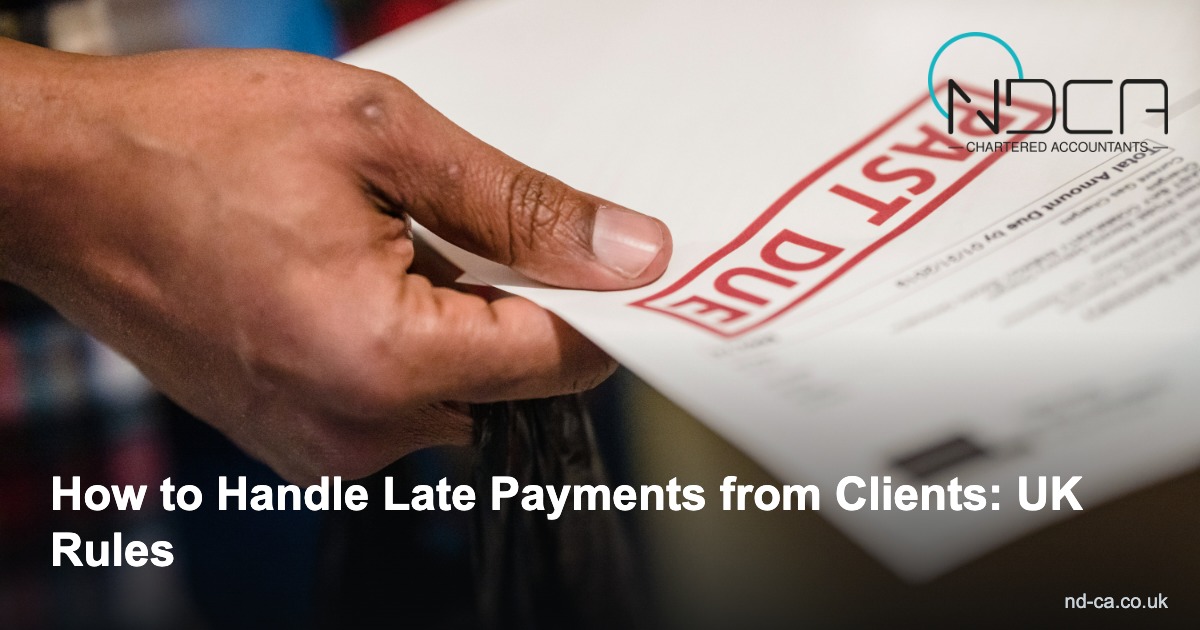
Late payments are one of the most damaging problems a small business or sole trader can face. This article explains your rights under UK law, the steps you can take to chase and recover what you are owed, and how to set up your business to prevent the problem from recurring. Whether you are a freelancer, a limited company director or a sole trader, the rules apply to you.
- UK late payment law explained
- Statutory interest and debt recovery costs
- How to chase overdue invoices step by step
- Formal debt recovery options
- Protecting your cash flow
- VAT and tax implications of late payments
- Prevention: terms, contracts and invoicing habits
- Frequently asked questions
UK late payment law explained
The main piece of legislation you need to know is the Late Payment of Commercial Debts (Interest) Act 1998. This gives businesses the right to charge interest on overdue invoices when trading with other businesses. It applies to contracts for the supply of goods or services where both parties are acting in the course of a business.
It does not apply to consumer debts, so if you are selling directly to members of the public, different rules apply and you would need to rely on your own contract terms or the courts.
Default payment terms under UK law
If you have not agreed payment terms in writing, the law sets a default. Under the 1998 Act, payment is due 30 days after the later of the invoice date or delivery, unless you have agreed something different. If you have agreed different terms, those terms apply, but any agreed period longer than 60 days must not be grossly unfair to the supplier.
Once a business invoice is overdue, you have the legal right to charge statutory interest from the day after payment was due.
Statutory interest and debt recovery costs
Under the 1998 Act, you can charge statutory interest at 8% over the Bank of England base rate. The base rate changes, so always check the current rate on the Bank of England website. The interest accrues daily on the outstanding balance.
On top of interest, you can also claim a fixed debt recovery cost to cover your administrative expenses:
- £40 for debts under £1,000
- £70 for debts between £1,000 and £9,999.99
- £100 for debts of £10,000 or more
You do not need to go to court to apply interest and these charges. You can add them to your invoice or a revised payment demand. Many businesses do not bother, but it is worth including them. It signals that you know your rights, and it sometimes prompts payment.
Do you have to charge statutory interest?
No. Charging statutory interest is your right, not an obligation. You can waive it if you have a long-term relationship with the client and prefer to handle it informally. But if a client is persistently late or owes a significant amount, using your legal right sends a clear message.
How to chase overdue invoices step by step
There is a right way to chase late payments. Being too passive means you wait months for money that is already yours. Being too aggressive too soon can damage a client relationship unnecessarily. A structured process works best.
Step 1: Send a payment reminder before the due date
A short, friendly reminder sent two or three days before the invoice is due is not pushy. It is professional. Many late payments happen simply because the invoice got lost or the client forgot. A quick email reminder prevents that.
Step 2: Follow up the day after the due date
If payment has not arrived on the due date, follow up the next working day. Keep the tone polite but direct. State the invoice number, the amount owed, the original due date and ask for an estimated payment date. Do not apologise for chasing.
Step 3: Escalate after seven days
If you have had no response or no payment after seven days, escalate. Send a more formal email or letter. Make clear that you are aware of your right to charge statutory interest and that you will do so if payment is not received within a specific deadline, typically seven to fourteen days.
Step 4: Final demand letter
If the client still has not paid, send a formal final demand. This should be in writing, state the total owed including any interest and recovery costs, give a final deadline of seven days and state clearly that you will pursue the debt through the courts or a debt recovery service if payment is not made. Send this by recorded post as well as email so you have proof of delivery.
Step 5: Take action
After your final deadline passes with no payment and no credible plan to pay, it is time to take formal action. You have several options, covered in the next section.
Formal debt recovery options
Small claims court
For debts up to £10,000 in England and Wales (£5,000 in Scotland, £3,000 in Northern Ireland), the small claims track in the county court is the most common route. You can make a claim online through the Money Claim Online (MCOL) service on GOV.UK. The court fee is based on the value of the claim and can usually be reclaimed from the debtor if you win.
The process is designed to be straightforward without a solicitor, although keeping detailed records (copies of invoices, emails, contracts and your payment terms) is essential.
Statutory demand
For debts over £750 owed by a company, or over £5,000 owed by an individual, you can serve a statutory demand. If the debtor does not pay or dispute the debt within 21 days, you can apply to have the company wound up or the individual made bankrupt. This is a serious step, but it is powerful: the threat alone often prompts payment from companies that want to protect their credit rating and reputation.
Debt collection agencies
You can hand the debt to a commercial debt collection agency. They typically take a percentage of what is recovered, so you will not receive the full amount. However, it removes the time and stress of chasing yourself. Choose an agency that is a member of the Credit Services Association.
Invoice factoring or discounting
If late payment is a persistent problem, invoice finance may help. Factoring means you sell your invoices to a finance company for an advance of typically 70 to 90% of the invoice value, and the finance company chases the debt. Discounting is similar but you retain control of the credit control process. Both come at a cost, so consider them carefully.
Protecting your cash flow
Late payments have a direct knock-on effect on your cash flow. Even profitable businesses can run into serious difficulties when clients pay late. If you cannot pay your own suppliers, your staff through payroll or HMRC on time, the consequences can be severe.
Keeping up-to-date bookkeeping means you always know exactly who owes you money, how much and for how long. That visibility means you can act quickly rather than realising months later that a client has not paid.
Management accounts produced monthly or quarterly will show you debtor days: how long on average it takes your clients to pay. If that figure is creeping up, it is a warning sign to tighten your credit control before cash flow becomes a crisis.
VAT and tax implications of late payments
VAT on bad debts
If you are VAT-registered and a client has not paid after six months from the due date, you can reclaim the VAT you already paid to HMRC on that invoice through bad debt relief. You must have already accounted for the VAT on your VAT returns, and the debt must have been written off in your accounts. Keep evidence that you have taken reasonable steps to recover the debt.
If the client eventually pays after you have claimed bad debt relief, you must repay the VAT to HMRC in the VAT period when payment is received.
Income tax and corporation tax
For sole traders doing self assessment, income is generally taxed on an accruals basis, meaning you pay tax on invoiced income even if the client has not paid. If a debt becomes genuinely irrecoverable, you can claim it as a bad debt expense to reduce your taxable profit.
For limited companies, the same principle applies to corporation tax. A specific bad debt provision, meaning a debt that is genuinely doubtful or irrecoverable, can reduce your taxable profits. General provisions (e.g. “assume 5% of debtors will not pay”) are not allowable for tax purposes.
Cashflow-based VAT: the cash accounting scheme
If your VAT-taxable turnover is below £1.35 million, you can use the VAT cash accounting scheme. Under this scheme, you only account for VAT when you actually receive payment, not when you raise the invoice. This is a significant benefit because it means you never have to pay VAT to HMRC before your client has paid you. If a client then never pays, you have never paid the VAT on that invoice in the first place, so there is no need to claim bad debt relief.
Prevention: terms, contracts and invoicing habits
The best way to handle late payments is to prevent them. Most businesses that suffer from persistent late payment have gaps in their processes that can be fixed without much effort.
Put your payment terms in writing
Every client engagement should start with a written contract or at minimum a written confirmation of your terms. This should state your payment terms clearly, for example, payment due within 14 days of invoice date. Without written terms, you are relying on the statutory 30-day default, and you will have less leverage in any dispute.
Invoice promptly and correctly
An invoice that is sent late, sent to the wrong person or missing required information gives a client an excuse to delay. Send invoices as soon as the work is complete or the goods are delivered. Make sure every invoice includes your business name and address, the client’s name and address, a unique invoice number, a clear description of what was supplied, the amount due and any VAT, your bank details and your payment terms.
Use accounting software
Software like Xero sends automatic payment reminders and lets you see at a glance which invoices are outstanding. If your team does not have time to keep it up to date, our bookkeeping service can keep your invoices and payments reconciled, which makes credit control much easier. Automated reminders sent at consistent intervals (say, seven days before due, on the due date and seven days after) are far more effective than chasing manually when you remember.
Automate collection with a dedicated payments platform
Accounting software will chase invoices for you, but it stops at sending a reminder email. Adfin goes a step further by combining invoicing, payment collection and reconciliation in one place. It connects to Xero and QuickBooks, generates instant payment links so clients can pay by card or bank transfer with one click, supports Direct Debit for recurring or larger contracts and automatically matches payments back to the right invoice once they land –. Cutting out the manual reconciliation work. For businesses that are chasing the same clients every month, that combination of automated chasing and one-click payment tends to shorten the time between invoice and payment considerably. You can set up an account through our referral link: adfin.com/referral/ndca-ltd-noor-817a4.
Ask for deposits or stage payments
For large projects, do not wait until completion to invoice. A deposit upfront, typically 25 to 50%, and stage payments tied to milestones mean you are never far out of pocket if a client relationship breaks down. This is standard practice in industries such as construction and creative services, and there is no reason not to apply it elsewhere.
Credit check new clients
For significant contracts, run a basic credit check on a new client before you start work. Credit reference agencies such as Creditsafe, Experian or Companies House filings can tell you a great deal about a company’s financial health. A client with a history of county court judgements against them is a risk worth knowing about before you take them on.
Consider a retention of title clause
If you supply goods rather than services, a retention of title clause in your contract means the goods legally remain yours until payment is received in full. This gives you the right to reclaim goods from an unpaid client rather than pursuing cash, though enforcing it in practice can be complicated, so take legal advice when drafting such a clause.
Frequently asked questions
How long can a client legally wait before paying an invoice in the UK?
Without agreed terms, the law gives your client 30 days from the invoice or delivery, whichever comes later. If you have agreed terms in writing (for example, 14 days) those terms apply, and terms beyond 60 days must also be fair to the supplier.
Can I charge interest on a late invoice without going to court?
Yes. Statutory interest is a legal right from the day after payment falls due, and you need no court order to add it. You can add the interest and a fixed debt recovery cost (£40, £70 or £100 depending on the debt size) to a revised payment demand and send it directly to the client.
What can I do if a client refuses to pay and ignores my emails?
Send a formal final demand by recorded post and email, stating a final deadline and your intention to take legal action. If that fails, start a claim through Money Claim Online or, for a company owing over £750, serve a statutory demand. A debt collection agency is another option if you prefer not to manage the process yourself.
Can I reclaim VAT if a client has not paid me?
Yes, provided the debt is more than six months overdue from the due date and you have already paid the VAT to HMRC. You can claim bad debt relief on your VAT return to recover the VAT element of the unpaid invoice. Any later payment from the client means paying that VAT back.
Does late payment law apply if I sell to consumers rather than businesses?
No. The 1998 Act covers business-to-business sales only. With consumers, your contract terms set the rules and the small claims court is the usual route to recovery.
How do I write off a bad debt for tax purposes?
You can deduct a specific bad debt from your taxable income once the debt is genuinely irrecoverable, meaning your recovery efforts have failed and the debt is written off in your accounts. For sole traders, this reduces the profit reported on your self assessment return. For limited companies, it reduces taxable profits for corporation tax purposes. General provisions for expected bad debts are not allowable for tax.
Need an accountant?
NDCA is an ACCA-regulated accountancy practice with fixed monthly fees and a named accountant. Book a free consultation and pick a time that suits you.