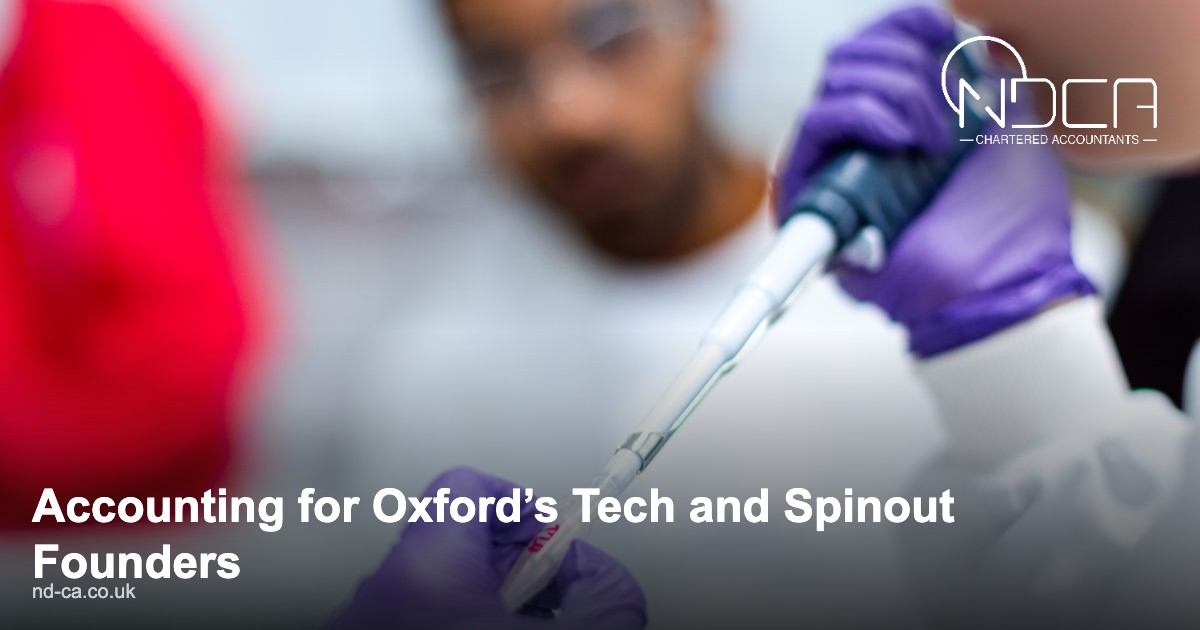
Oxford tech and spinout founders face accounting challenges most small businesses never see. Oxford has one of the densest concentrations of university spinouts and early-stage tech businesses in the UK, built on decades of research coming out of the university’s science departments. If you’re founding or running a tech company in Oxford, whether it’s a SaaS product, a deep-tech spinout, or an AI-driven startup, your accounting needs look different from a typical small business. This article covers the areas that matter most: R&D tax relief, investor-ready accounts, SEIS/EIS, and the cash flow discipline that keeps an early-stage company alive.
- R&D tax relief: what qualifies and what founders miss

- SEIS and EIS: keeping your company investment-ready
- Cash flow discipline before you’re profitable
- Choosing accounting software that scales with you
- When to bring in management accounts
Oxford tech and spinout founders: R&D tax relief, what qualifies and what founders miss
Most Oxford spinouts and tech companies are doing something that qualifies for R&D tax relief, whether that’s software development that resolves genuine technical uncertainty, or product engineering that goes beyond routine application of existing techniques. The relief can be claimed as a cash credit even before you’re profitable, which makes it one of the most valuable reliefs available to a pre-revenue company.
Oxford tech and spinout founders commonly miss two things. First, they under-claim because they assume only “lab science” counts, when a meaningful share of software and engineering work also qualifies. Second, they claim too late, after year-end, when the supporting technical narrative and cost records should really be built up as the work happens. A named accountant who understands your business can flag qualifying work in real time rather than reconstructing it from memory eight months later.
SEIS and EIS: keeping your company investment-ready
If you’re planning to raise from angels or an Oxford-based seed fund, your company structure and accounts need to support SEIS or EIS relief for your investors. That means getting advance assurance from HMRC before you raise, structuring share classes correctly, and keeping your accounts clean enough that due diligence doesn’t stall your round. Getting this wrong, or leaving it until a term sheet lands, is one of the most common reasons early raises get delayed.
Cash flow discipline before you’re profitable
Pre-revenue and early-revenue companies live and die by runway. Monthly cash flow forecasting, not just a bank balance check, tells you how many months you actually have before you need to raise again or cut costs. This matters more in Oxford than it might elsewhere, because grant funding, R&D credits, and investment tranches often land at irregular intervals rather than as smooth monthly income.
Choosing accounting software that scales with you
Xero, run properly from day one, gives you live visibility into cash position and lets your accountant work from the same numbers you’re looking at, rather than reconciling a spreadsheet once a quarter. For a spinout or tech company, this also makes due diligence far faster when an investor or acquirer eventually asks for your books.
When to bring in management accounts
Once you have a handful of employees or your first significant contract, a bank balance is no longer enough to run the business on. Monthly management accounts, revenue by product line, burn rate, and runway, give founders and their boards the information needed to make decisions before problems become emergencies.
NDCA works with tech founders and spinouts across Oxford on a fixed monthly fee, through Xero, with a named accountant who understands R&D claims and investor reporting. If you’re building a company in Oxford, we can talk through what your accounts should look like at your stage. This is the kind of support Oxford tech and spinout founders need most in the early years, before the accounting side becomes a distraction. For official guidance, see HMRC’s guidance on R&D tax relief.
Do you work with pre-revenue startups?
Yes. A large share of our tech clients are pre-revenue or early-revenue. We build in R&D tax relief and investor reporting from the start rather than adding it later.
Can you help with an SEIS or EIS advance assurance application?
Yes, we prepare and submit advance assurance applications and structure your accounts so due diligence doesn’t slow your round down.
Do you have an office in Oxford?
No. NDCA is remote first, with clients across the UK. Oxford founders work with us over video and a shared live Xero file, and never need to visit an office.
Areas we cover
NDCA works with clients across the following regions. If you’re based in one of these areas, our team can help with the accounting issues covered in this article.