Last updated: 24 October 2026 · Current UK tax year: 2026/27
If you earn money from YouTube, Instagram, TikTok, a podcast, a blog or any other platform, HMRC treats you as running a business. That means you can deduct allowable expenses from your income before you pay tax. This article explains exactly what expenses a UK content creator can claim, how the rules work in practice, and what to watch out for so you do not fall foul of HMRC.
- What counts as an allowable expense?
- Equipment and technology
- Software and subscriptions
- Home office costs
- Travel and transport
- Clothing and costumes
- Props, products and review items
- Marketing, branding and professional services
- Education and research
- PR, gifted items and free products
- Sole trader versus limited company: does it matter?
- Keeping records and staying compliant
- Frequently asked questions
What counts as an allowable expense?
HMRC allows you to deduct expenses that are incurred “wholly and exclusively” for your business. That phrase is the golden rule. If a cost is purely for your content creation business, it is almost certainly allowable. If it is a personal cost dressed up as a business one, HMRC will not accept it. Where something has a genuine dual purpose, you may be able to claim the business proportion only.
Content creators often struggle here because so much of everyday life can feel like work. Buying clothes to wear on camera, eating at a restaurant you plan to review, or subscribing to a streaming service for research all sit in a grey area. The test is always whether the expense would exist if you had no business at all.
Equipment and technology
This is the area where most content creators have the clearest claims. The cost of equipment that you use to produce your content is a legitimate business expense.
What you can claim
- Cameras, lenses, lighting rigs and tripods
- Microphones, audio recorders and headphones
- Smartphones and tablets used primarily for content
- Laptops and desktop computers for editing
- External hard drives, memory cards and storage
- Gimbals, drones and other specialist filming kit
- Green screens and studio backdrops
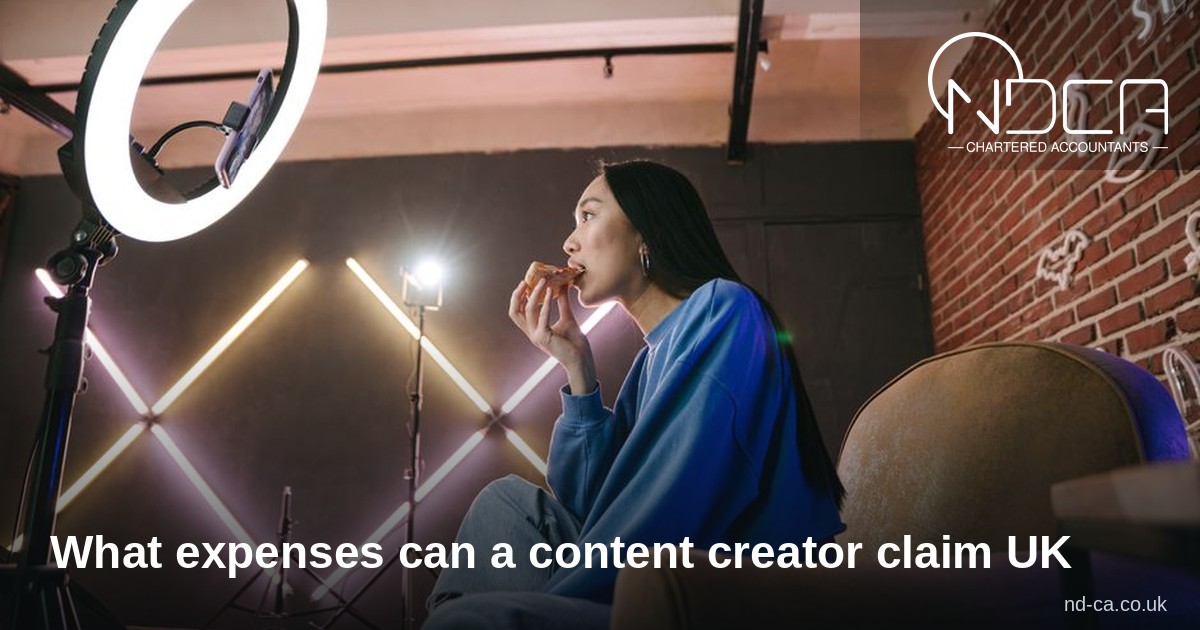
- Ring lights and other photography lighting
Annual investment allowance
Under the Annual Investment Allowance (AIA), most content creators can deduct the full cost of qualifying equipment in the year of purchase rather than spreading the relief over several years. The AIA limit is set well above what the typical creator spends on kit each year, so in practice you will deduct the full amount immediately. Check the latest HMRC guidance for the current AIA limit if you are making a very large purchase.
If you use a piece of equipment partly for personal use, you must reduce the claim to reflect the business proportion. So if you use your laptop 80% for work and 20% for personal browsing, you can claim 80% of the cost.
Software and subscriptions
Software costs are generally fully deductible as a revenue expense in the year you pay them.
Common software claims for creators
- Video editing software (Adobe Premiere Pro, Final Cut Pro, DaVinci Resolve)
- Photo editing tools (Adobe Lightroom, Photoshop, Canva Pro)
- Thumbnail design and graphic tools
- Music licensing subscriptions (Epidemic Sound, Artlist)
- Cloud storage (Google Drive, Dropbox, iCloud if used for business files)
- Project management and scheduling tools
- Social media scheduling platforms (Later, Hootsuite, Buffer)
- Analytics tools and SEO software
- Screen recording and captioning software
Streaming service subscriptions are trickier. If you subscribe to Netflix purely to review content or carry out research for your channel, you may have a case. If you also watch it for personal enjoyment, the claim becomes far harder to justify and HMRC is likely to challenge it.
Home office costs
Many content creators work from home, so claiming a proportion of household costs is entirely legitimate. You have two options.
Simplified flat rate (for sole traders)
HMRC publishes flat rates based on the number of hours you work from home each month. These are straightforward to use and require no calculation of actual costs. Check the latest HMRC guidance for the current flat rate figures, as they are updated periodically.
Actual cost method
Alternatively, you can work out the proportion of your home that is used exclusively for work and claim that fraction of your mortgage interest or rent, council tax, utility bills and broadband. A common approach is to divide the number of rooms used for work by the total number of rooms, then apply that fraction to the relevant bills. This method often produces a higher deduction but requires more record-keeping.
Note that if you use a room purely and exclusively as a studio or office, you could face a capital gains tax issue when you sell your home, as that room loses its private residence relief. Most creators use a room for mixed purposes, which avoids this problem but also limits the deduction to the business proportion of time used.
Travel and transport
Travel costs incurred wholly for business purposes are deductible. The journey from your home to a regular, permanent place of work is not allowable (that is ordinary commuting), but content creators rarely have a fixed external workplace, so most business travel qualifies.
What you can claim
- Train, bus and tube fares to attend brand events, shoots or meetings
- Flights and accommodation for work trips
- Taxis and ride-sharing for business journeys
- Car mileage at HMRC’s approved mileage rate (45p per mile for the first 10,000 miles, then 25p per mile, check the latest HMRC guidance to confirm current rates)
- Parking and road tolls on business journeys
Holiday content is one of the most heavily scrutinised areas. If you travel somewhere primarily for a holiday and film some content while you are there, HMRC will not allow the full travel cost as a deduction. The primary purpose must be business. Keep a clear record of the business itinerary: meetings attended, shoots completed and brands liaised with on location.
Clothing and costumes
This is one of the most misunderstood areas for content creators. HMRC’s position is clear: ordinary clothing is not deductible, even if you buy it specifically to wear on camera. The reason is that clothing can be worn outside of work, so it does not meet the “wholly and exclusively” test.
What you can claim is clothing that is a costume or branded prop rather than everyday wear. A specific character costume, a uniform with your brand logo printed on it, or safety clothing worn on set can all qualify. If you buy a dress to wear in a fashion haul video and then wear it in your everyday life, that is a personal expense.
Props, products and review items
Products you buy specifically to review, unbox or demonstrate in your content are business expenses. Keep the receipt and make a note of which video or post the item featured in. If you later keep and use the product personally, HMRC may view it as a benefit in kind (if you operate through a limited company) or a private benefit that reduces the allowable deduction.
Set dressing, backgrounds, props and any physical items used solely on set or in content production are generally allowable.
Marketing, branding and professional services
Costs incurred to market your channel, build your brand and run your business professionally are fully deductible.
Examples
- Graphic design fees for logos, channel art and thumbnails
- Website hosting and domain name fees
- Paid advertising (Google Ads, Meta Ads, TikTok Ads)
- PR agency fees
- Accountancy and bookkeeping fees (yes, your accountant’s fee is deductible)
- Legal fees for contract review
- Agent or management fees
- Virtual assistant or content manager costs
- Video editor fees if you outsource editing
If you work with a content creators specialist accountant, their fee comes off your tax bill as well as saving you time.
Education and research
Training and education costs are allowable if they relate to a skill you already use in your business. A video editing masterclass, a photography course or a course on social media strategy would normally qualify. A qualification in a completely new field that you might pivot to in future is less likely to qualify because it is developing a new skill rather than maintaining or improving an existing one.
Books, magazines and online resources bought for research into your niche are deductible. If your channel covers personal finance, buying books about investing or tax is reasonable. If your channel covers food, buying restaurant guides or recipe books for content purposes is arguable, though HMRC would look closely at a claim where there is obvious personal benefit too.
PR, gifted items and free products
This is a tax area that trips up many creators. When a brand sends you a free product in exchange for a review or promotion, HMRC may treat that product as taxable income equal to its market value. You do not pay for it, but you have received something of value as part of your trade.
You must report the value of gifted items as income on your tax return. The good news is that if you then give the product away (in a giveaway to your audience, for example), or it is a sample you return, you may have a deduction to match. Keep clear records of everything received for free and its approximate retail value.
If you send gifts to collaborators or brand partners, HMRC limits the deduction for business gifts to £50 per recipient per year (check the latest HMRC guidance as this limit can change). Gifts that carry a conspicuous advertisement for your brand are treated differently, so seek advice if this applies to you.
Sole trader versus limited company: does it matter?
The expenses you can claim are broadly similar whether you operate as a sole trader or through a limited company. The difference lies in how the tax relief flows through.
As a sole trader, allowable expenses reduce your taxable profit before you calculate income tax. In 2026/27, income above £12,570 (the personal allowance) is taxed at 20% up to £50,270, then at 40% up to £125,140, and at 45% above that. Claiming every legitimate expense therefore saves you tax at your marginal rate.
As a limited company director, the company deducts expenses before paying corporation tax. In 2026/27, the small profits rate is 19% on profits under £50,000 and the main rate is 25% on profits over £250,000, with marginal relief in between. Expenses claimed through the company save corporation tax. You may also draw a salary and dividends, and the tax planning around that structure is more involved.
If you are not sure which structure suits you, or you are thinking about incorporating your content business, company formation advice from a specialist accountant will pay for itself quickly.
For sole traders and limited company directors alike, a self assessment return is required if your income from content creation is above HMRC’s reporting threshold. From April 2026, Making Tax Digital for income tax applies to self-employed people and landlords with income over £50,000, which will change how you file quarterly updates with HMRC.
Keeping records and staying compliant
HMRC expects you to keep records of all income and expenses for at least five years after the self assessment deadline for the relevant tax year. For content creators, that means:
- Saving receipts and invoices (digital copies are fine)
- Recording income from each platform, brand deal and affiliate programme
- Keeping a log of business mileage if you use a car
- Noting the business purpose of any borderline expense at the time you incur it
- Keeping a list of gifted products received and their approximate value
Good records make your tax return straightforward and protect you if HMRC ever opens an enquiry. Disorganised records, on the other hand, can result in HMRC disallowing legitimate claims simply because you cannot evidence them.
NDCA’s bookkeeping service handles this for you on a monthly basis, so your records are always current and your tax return is never a last-minute scramble. If your records have fallen behind, our bookkeeping catch-up service can bring everything up to date quickly.
If you are already working with another accountant but feel you are not getting the specialist advice your content business needs, switching accountants is simpler than most people expect.
NDCA is an ACCA-regulated accountancy practice working with content creators across the UK. We offer fixed monthly fees, a named accountant and same-day replies to queries. Get in touch to find out how we can help you pay the right amount of tax and not a penny more.
Frequently asked questions
Can I claim my phone bill as a content creator?
Yes, but only the business proportion. If you use your phone 60% for content creation and 40% personally, you can claim 60% of the monthly contract cost. Keep a record of how you calculated the split in case HMRC asks.
Are gifted products taxable income for UK content creators?
Generally yes. If a brand sends you a free product in return for a review or a post, HMRC treats the market value of that product as taxable income. You must include it in your self assessment return. Keep a log of everything you receive and its approximate retail price.
Can I claim food and drink as a content creator?
Only in limited circumstances. If you travel away from home overnight for a business purpose, subsistence costs (meals and drinks while away) are allowable. Day-to-day meals while working from home are not. If your channel is specifically about food and you buy ingredients solely to create recipe content, that cost is more defensible, but you should document the business purpose clearly.
What is the difference between a capital expense and a revenue expense for creators?
A revenue expense is a running cost you pay regularly, such as software subscriptions or editing fees. These are deducted in full in the year you pay them. A capital expense is a one-off purchase of an asset with a lasting value, such as a camera or a laptop. Capital expenses are claimed through capital allowances (usually the Annual Investment Allowance), which for most creators also gives full relief in the year of purchase.
Do I need to charge VAT if I earn over £90,000 from content creation?
Yes. Once your taxable turnover exceeds £90,000 in a rolling 12-month period (the VAT registration threshold in 2026/27), you must register for VAT with HMRC. Once registered, you charge VAT on your services and submit regular VAT returns. Some brand deals with overseas clients may be zero-rated, so the rules can be complex. Take specialist advice as soon as you approach the threshold.
Can I claim expenses before my content channel started making money?
Yes, within limits. Pre-trading expenditure incurred in the seven years before your business officially started can be treated as if it were incurred on the first day of trading, provided the costs would have been allowable had the business already been running. Keep all receipts from the set-up phase, as these costs can reduce your first year’s tax bill.
Want an accountant to handle this for you?
NDCA is an ACCA-regulated accountancy practice with fixed monthly fees and a named accountant who normally gets back to you the same day.