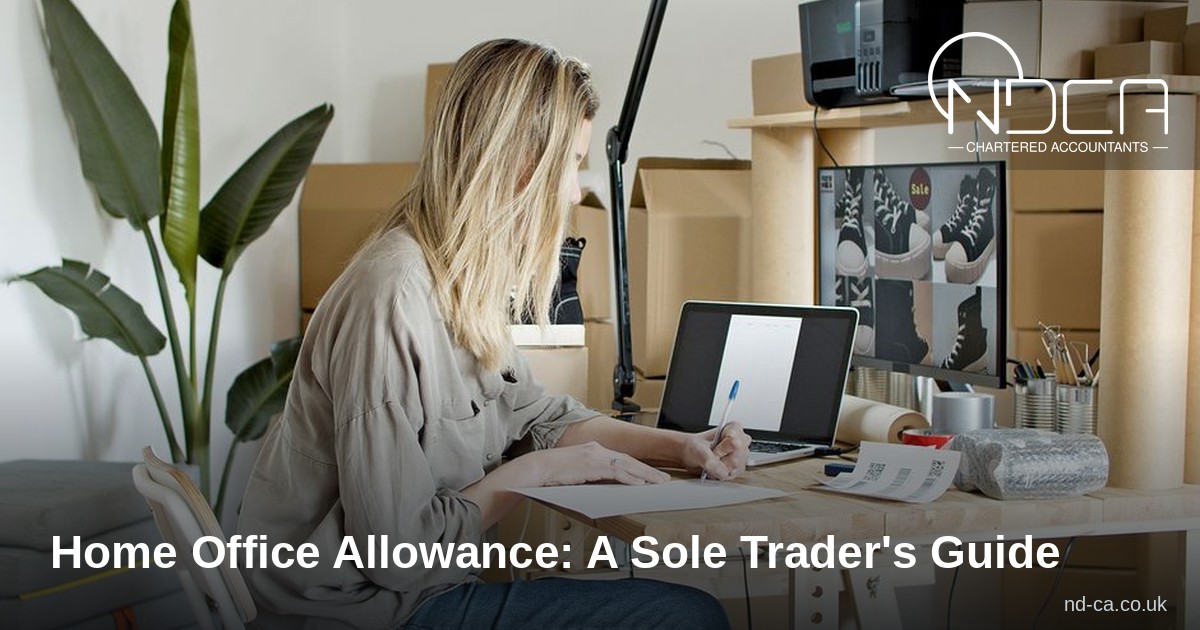
If you work from home as a sole trader, you can claim a portion of your household running costs as a business expense, which reduces your taxable profit and your tax bill. This guide explains the two methods available, what you can and cannot claim, and how to record everything correctly on your self assessment tax return.
- What is the home office allowance?
- Who can claim it?
- The two methods: flat rate vs actual costs
- Method 1: The simplified flat rate (HMRC approved hours)
- Method 2: Claiming actual costs
- What you cannot claim
- Record-keeping and evidence
- Putting it on your self assessment return
- Making Tax Digital and home office costs
- Frequently asked questions
What is the home office allowance?
The home office allowance is a tax deduction that lets sole traders claim part of their household costs against their business income. Because you are using your home partly for work, HMRC accepts that a proportion of bills like heating, electricity, and broadband are a legitimate business expense.
The deduction sits on your self assessment tax return under allowable business expenses. It reduces your net profit, and therefore the income tax and Class 4 National Insurance you owe. Even a modest claim can save a basic-rate taxpayer around £200–£400 a year, more if you work from home full time.
Who can claim it?
You can claim the home office allowance if you are a sole trader or a partner in a business partnership, and you genuinely use part of your home for work. That work must be substantive, not just the occasional email checked on the sofa.
You do not need a dedicated office room. HMRC accepts that you can use a kitchen table or a spare bedroom part of the time. What matters is that you actually work from home regularly as part of running your business.
This guide covers sole traders specifically. If you operate through a limited company, the rules are different. Your company would need to pay you a formal rental charge or a use-of-home fee, which has its own tax implications.
Freelancers, tradespeople who use home as their base of operations, content creators, and healthcare professionals running private practices can all use this deduction, provided they meet the basic test of working from home regularly.
The two methods: flat rate vs actual costs
HMRC gives sole traders two ways to calculate the home office deduction. You pick one method per tax year. You cannot mix and match within the same return.
- Simplified flat rate: A fixed monthly amount based on how many hours per month you work from home. No receipts needed for household bills.
- Actual costs: A calculated proportion of your real household expenses. More work to calculate, but often produces a larger deduction.
Neither method is automatically better. The right choice depends on your household costs, how much space you use, and how many hours you work at home each month.
Method 1: The simplified flat rate (HMRC approved hours)
The simplified expenses method lets you claim a standard monthly amount without having to dig out utility bills. HMRC sets the rates based on the number of hours you work from home each month.
Current flat rates (2026/27)
- 25 to 50 hours per month: £10 per month
- 51 to 100 hours per month: £18 per month
- 101 or more hours per month: £26 per month
These figures are set by HMRC. Check the latest HMRC guidance if you want to confirm current rates, as they can be updated. At the top rate, you can claim up to £312 per year without producing a single household receipt.
How to track your hours
You need to keep a record of how many hours per month you work from home. A simple spreadsheet or a note in your diary works fine. HMRC does not prescribe a format, but you do need to be able to show the figures if asked.
Count only hours spent doing actual work, not hours where you are at home but not working. If you work 30 hours from home in one month, you claim the 25–50 band for that month.
When the flat rate makes sense
The flat rate suits you if your home running costs are low, your property is large relative to the space you use for work, or you simply want a simple approach with no administration. It is particularly useful when you are just starting out and your bookkeeping system is still basic.
Method 2: Claiming actual costs
The actual costs method lets you claim a proportion of your real household expenses. It takes more effort to calculate, but it often produces a larger deduction, especially if you work from home most of the week or have high energy bills.
Which expenses can you include?
- Gas and electricity
- Water rates (if you use water as part of your work)
- Broadband and internet costs (the business-use portion)
- Mortgage interest (not capital repayment, and be careful, as this can affect Capital Gains Tax relief on your home if you claim it)
- Rent (if you are renting your home)
- Council Tax
- Home insurance
- Cleaning costs for the workspace area
You cannot claim the full cost of any of these. You must apportion them to reflect only the business-use portion.
How to calculate the business proportion
The most common approach is to divide by the number of rooms in the house, then multiply by the proportion of time that room is used for work.
For example, suppose your home has five rooms (excluding bathrooms) and you use one room as a dedicated office. Your space proportion is one fifth, or 20%. If that room is used for business eight hours a day, five days a week, and is not used for personal purposes in the evenings or weekends, the time proportion might be around 60–70%. Multiply the two together and you get your overall business-use percentage.
In practice, most sole traders use a room for both work and personal purposes. If you use your kitchen table for work during the day and family meals in the evening, adjust your time proportion accordingly.
A worked example
Say your total household bills for the year are:
- Electricity and gas: £2,400
- Broadband: £360
- Council Tax: £1,800
- Total: £4,560
You have a five-room house and use one room for work. Space proportion: 20%. You use that room for work roughly 40% of the time (around 8 hours a day, 5 days a week, with personal use in the evenings and weekends). Overall proportion: 20% × 40% = 8%.
Claimable amount: £4,560 × 8% = £365 per year. That is already higher than the flat-rate maximum of £312, and this example uses relatively modest household bills.
Broadband: a note
If you use broadband partly for business and partly personally, you can only claim the business-use proportion. If it is used exclusively for business, you can claim 100%. Most sole traders working from home can reasonably claim 50–80% of broadband costs as a business expense, depending on their circumstances.
When actual costs make sense
The actual costs method works best if you have a dedicated home office, high household bills, or you work from home almost every day. It requires you to retain all your household bills for at least five years after the relevant tax return deadline, so your record-keeping needs to be solid.
What you cannot claim
There are clear boundaries on what HMRC will accept. Getting this wrong can lead to penalties if you are investigated.
- Capital costs: You cannot claim the purchase price of furniture, fixtures, or building alterations under the home office allowance. These may be claimable separately as capital allowances, so get advice if you have spent a significant amount.
- Mortgage capital repayment: Only mortgage interest may be claimable, and even then, exercise caution (see below).
- Council Tax (flat rate method):If you use the flat rate, council tax is already factored in. Do not claim it separately.
- Full cost of any bill: You must always apportion. Claiming 100% of your gas bill as a business expense when you live in the property will not stand up to scrutiny.
- Wholly personal expenses: Netflix, personal telephone calls, or any cost that has no business purpose cannot be claimed.
A word on mortgage interest and Capital Gains Tax
Claiming mortgage interest as a business expense can affect the Capital Gains Tax private residence relief you receive when you eventually sell your home. If you claim that part of your home is used exclusively for business, HMRC may argue that the same part does not qualify for full private residence relief. For most sole traders who use a room partly for personal use as well as work, this is not an issue, but if you have a genuinely dedicated office that is never used personally, take advice before claiming mortgage interest.
Record-keeping and evidence
Good records protect you if HMRC ever queries your return. You do not need to be elaborate, but you do need to be consistent.
For the flat rate method
- A monthly log of hours worked from home
- A note of which HMRC band applies each month
For the actual costs method
- Copies of all household bills (gas, electricity, broadband, council tax, insurance)
- Your written calculation showing how you arrived at the business proportion
- A floor plan or room count if you are apportioning by space
- A record of hours worked at home if you are also apportioning by time
HMRC can request records going back up to five years after the 31 January filing deadline. Keep everything at least that long. Digital copies are fine: scan your bills and store them in a cloud folder.
If your records are kept in Xero, digital receipts can be attached directly to each transaction. If you are not yet using cloud accounting, our bookkeeping service can set Xero up for you and keep your records up to date.
Putting it on your self assessment return
The home office deduction goes on the self-employment pages of your self assessment tax return, under allowable business expenses. The specific box is “Office costs” or “Other allowable business expenses” depending on how you are completing the return.
If you are filing online through HMRC’s system, you will see a section for business expenses. Enter the total amount you are claiming for the year, either your flat-rate total or your calculated actual costs figure. You do not need to attach receipts at this stage, but you must be ready to provide them if HMRC raises an enquiry.
If you are using an accountant to prepare your return, give them your calculation and supporting records. They will enter the figure in the correct place and make sure it is consistent with the rest of your return.
The self assessment deadline for online filing is 31 January following the end of the tax year. For 2025/26, that means 31 January 2027.
Making Tax Digital and home office costs
From April 2026, sole traders and landlords with income over £50,000 must use Making Tax Digital for Income Tax. This means submitting quarterly updates to HMRC through approved software, with a final year-end declaration replacing the traditional self assessment return.
Under MTD for Income Tax, your home office costs will still be claimed as a business expense, but you will need to categorise them correctly in your software from the start of each quarter rather than just at year end. This makes good record-keeping even more important.
If your income is below £50,000, MTD for Income Tax does not apply to you yet. The threshold drops to £30,000 from April 2027, and to £20,000 at a date yet to be confirmed by HMRC.
Frequently asked questions
Can I claim the home office allowance if I only work from home part of the time?
Yes. You can claim for the months or hours you do work from home. With the flat-rate method, you simply apply the appropriate band for each month based on the hours worked at home that month. If you worked from home for only part of the year, you only claim for those months.
Do I need a dedicated room to claim home office expenses?
No. HMRC does not require a separate room. You can claim if you work at a kitchen table, a corner of a bedroom, or any other part of your home, provided you genuinely use that space for business. However, having a dedicated room makes it easier to calculate the space proportion for the actual costs method.
Can I claim both the flat rate and actual costs in the same year?
No. You must choose one method for the full tax year. You can switch methods from one year to the next, but within any single tax year it is one or the other.
What if I rent my home, can I still claim?
Yes. Rent is one of the costs you can include when using the actual costs method. Apportion it using the same room and time proportions as your other bills. There is no Capital Gains Tax concern with rented property, so renting can actually make the actual costs calculation simpler.
Will claiming home office expenses trigger an HMRC investigation?
Claiming legitimate business expenses, including home office costs, does not in itself attract HMRC attention. HMRC selects returns for enquiry based on various risk factors, and reasonable home office claims are standard. What matters is that your claim is accurate and you can back it up with records if asked.
Can a sole trader claim phone costs as well as home office costs?
Yes, but separately. If you use a mobile phone for business, you can claim the business-use proportion of the bill. If you have a dedicated business phone, you can claim 100%. Phone costs are usually entered under “Phone, fax and stationery” on the self assessment return, not under office costs, so keep them separate in your records.
Want your home office claim done properly?
NDCA is an ACCA-regulated accountancy practice with fixed monthly fees and a named accountant who normally gets back to you the same day.