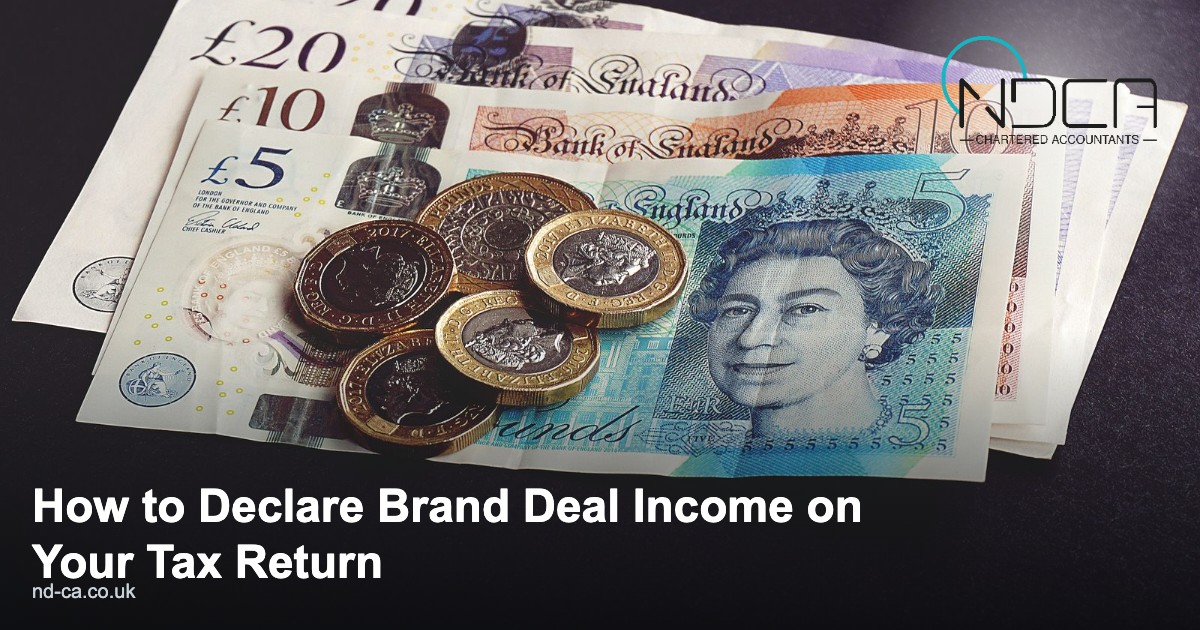
If you are a content creator, influencer or freelancer earning money from brand deals, you need to declare that income to HMRC, even if it is a side income on top of a regular job. This article explains exactly what counts as taxable brand deal income, how to report it on your self assessment tax return, what expenses you can claim and what happens if you receive payment in products rather than cash. This guide covers exactly how to declare brand deal income on your tax return. If most of your income comes from one platform, our Instagram influencer and YouTuber accountant pages cover the tax points specific to each.
- What counts as brand deal income?
- Do you need to register for self assessment?
- How to report brand deal income on your tax return
- Gifted products and non-cash payments
- Expenses you can claim against brand deal income
- VAT and brand deals
- Limited company or sole trader: which is better for brand deals?
- Keeping records of brand deal income
- Frequently asked questions
What counts as brand deal income?
Brand deal income is any payment you receive in exchange for promoting, reviewing or featuring a product or service on your platform. This includes:- Flat-fee sponsored posts or videos
- Commission or affiliate payments (including recurring referral fees)
- Usage fees for content the brand repurposes
- Appearance fees for brand events or campaigns
- Royalties from licensed content
- Products, services or experiences given in exchange for promotion
Do you need to register for self assessment?
Registering on time matters as much as filing correctly. You must register for self assessment and complete a tax return if your brand deal income exceeds £1,000 in a tax year. This is the trading allowance threshold. Once you go over that figure, HMRC expects you to declare it. You must also register if any of the following apply:- Your total self-employment income (including brand deals) is over £1,000
- You earn over £100,000 from employment in the same tax year
- You have untaxed income from other sources that HMRC needs to know about
How to Declare Brand Deal Income on Your Tax Return
It starts with picking the right section of your return. If you are a sole trader (which most content creators and freelancers are), you report brand deal income in the Self-Employment section of your self assessment tax return. You will declare:- Your total turnover: every payment you received, including non-cash payments at their market value
- Your allowable expenses: costs you incurred wholly and exclusively for the purpose of the work
- Your net profit: turnover minus expenses
What if brand deals are a side income alongside employment?
If you have a regular PAYE job and earn brand deal income on the side, you still need to complete a self assessment return. Your employment income is taxed at source, but your self-employment profit is added on top. This means your brand deal profit could be taxed at 40% if your combined income takes you over the basic rate threshold of £50,270.Gifted products and non-cash payments
Gifts and freebies are the payments people most often forget. Receiving free products, hotel stays, event tickets or other perks in exchange for content counts as income. HMRC calls these “benefits in kind” when they arise in employment, but for self-employed content creators they are treated as trading income at their market value. If a brand sends you a £400 camera in exchange for a review video, you must include £400 in your turnover. If you later sell that camera, you may also have a capital gain to consider, though the annual capital gains allowance in 2026/27 is £3,000 before any tax is due. There is a narrow exception: if a product is genuinely unsolicited and you have no obligation to post about it, HMRC may not treat it as income. But if there is any expectation of content in return (written, verbal or implied) treat it as taxable. The safe approach is always to declare it.Expenses you can claim against brand deal income
You can deduct expenses that are incurred wholly and exclusively for the purpose of your business. For content creators, this commonly includes:- Camera equipment, lighting, microphones and accessories
- Software subscriptions (editing software, scheduling tools, design apps)
- Props and costumes used specifically for content
- Home office costs (using HMRC’s simplified flat rate or an apportionment of actual costs)
- Phone and internet bills: the business proportion only
- Travel costs to attend brand events or shoots
- Accountancy fees
- Training courses directly relevant to your content business
Capital allowances on equipment
Equipment like cameras and computers is a capital asset rather than a revenue expense. You claim the tax relief through capital allowances, typically via the Annual Investment Allowance (AIA). This lets you deduct the full cost of qualifying plant and machinery in the year you buy it, up to £1 million a year. Good bookkeeping is essential here. Keep every receipt, and record what each item was used for and when you bought it.VAT and brand deals
If your total taxable turnover from self-employment exceeds £90,000 in a rolling 12-month period (the 2026/27 registration threshold), you must register for VAT. For most early-stage content creators, this will not be an issue straight away, but it catches people out faster than they expect once brand deals scale up. Once you are VAT registered, you charge VAT on your services to brands. If the brand is VAT registered, this is usually straightforward. They reclaim the VAT on their end. If you are providing services to overseas brands, the place of supply rules apply and the treatment can differ. Speak to an accountant before assuming you do not need to charge VAT on an international deal. If you need help with VAT returns, getting the figures right from the start saves a significant amount of hassle later.Limited company or sole trader: which is better for brand deals?
Most content creators start out as sole traders, and for many it stays the most practical structure. As your brand deal income grows, a limited company can reduce your overall tax bill in some cases. There is no single income level at which incorporation automatically becomes more tax efficient, so take advice on your own figures.Operating as a sole trader
Simple to set up, no Companies House filings and you report everything through self assessment. You pay income tax on profit at the rates described above, plus National Insurance. The downside is that all profit is taxable in the year it arises, even if you do not withdraw it.Operating through a limited company
In 2026/27, the corporation tax rate for small companies (profits under £50,000) is 19%. You can pay yourself a salary up to the National Insurance threshold, then take the rest as dividends. In 2026/27, the dividend allowance is £500. Dividend income above that is taxed at 10.75% (basic rate), 35.75% (higher rate) or 39.35% (additional rate), which is lower than income tax rates at the same level. The trade-off is more administration: annual accounts, corporation tax returns and Companies House filings. You will also need a payroll setup if you pay yourself a salary. Whether it is worth it depends on your profit level and how you want to manage your income.Keeping records of brand deal income
HMRC can investigate your tax return up to four years after filing, or longer if they suspect negligence or fraud. That makes good record-keeping non-negotiable. For each brand deal you complete, keep:- The contract or written agreement (even a confirming email counts)
- Invoices you raised or payment confirmations you received
- Bank statements showing payment dates and amounts
- Records of any products received and their market value
- Receipts for expenses you are claiming
Frequently asked questions
Do I have to pay tax on brand deals if I only earn a small amount?
At £1,000 or less in total, the trading allowance covers it and nothing needs declaring. Above £1,000, you must register for self assessment and report the income. There is no minimum profit threshold below the personal allowance. You still have to report it, even if you end up owing no tax.Are gifted products from brands taxable?
Yes, if you receive a product in exchange for content, even if no cash changes hands, HMRC treats the market value of that product as taxable income. You should include it in your turnover at what the product would cost to buy retail.Can I claim my phone and internet as expenses for brand deal work?
You can claim the business proportion of your phone and broadband costs. If you use your phone 60% for content creation work, you can deduct 60% of the bill. Keep a record of how you arrived at that proportion in case HMRC ever asks.What if a brand pays me in a foreign currency?
You must convert the payment to pounds sterling using the exchange rate at the date of receipt. HMRC accepts HMRC’s published exchange rates or the rate you actually received from your bank. Keep a record of the conversion so you can demonstrate the figure you declared.Do I need to tell HMRC about brand deals if I have a full-time PAYE job?
Yes. If your brand deal income exceeds the £1,000 trading allowance, you must register for self assessment and complete a tax return, regardless of whether you also pay tax through PAYE. Your self-employment profit is added to your employment income, and your total liability is calculated from there.When is the deadline to submit my self assessment tax return?
The online filing deadline for a self assessment tax return is 31 January following the end of the tax year. For the 2025/26 tax year, which ended on 5 April 2026, the deadline is 31 January 2027. For the 2026/27 tax year, the deadline is 31 January 2028. Any tax owed for the year is also due on 31 January, so do not leave it until the last minute. Getting this right first time avoids penalties later.Need an accountant for your creator income?
NDCA is an ACCA-regulated accountancy practice with fixed monthly fees and a named accountant. Book a free consultation and pick a time that suits you.